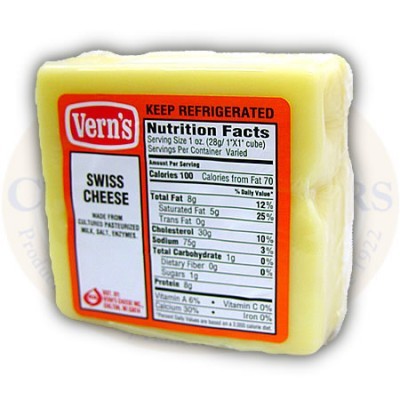
American cheesemakers, not Swiss, modernized Swiss production. About fifty years ago, the only way to protect Swiss wheels as they ripened was to allow a hard rind to form. The advent of plastic packaging, which keeps moisture in but allows carbon dioxide to escape, made it possible to produce rindless Swiss cheese in blocks. Rindless blocks were developed for better yield in foodservice; retailers appreciate the higher yield and ease of cutting.
Description:
Full-flavored, buttery, nutty. Made with part skim milk; aged at least 60 days. Ideal for table, or on sandwiches and casseroles sliced and melted.
Posted by From the former Swiss cheese capitol of the World, Monroe, WI on 15th Sep 2011
At a small cheese factory South-West of Verona, Wisconsin (for those who know the area, it later became The Village Tap bar, since tore down), the first block Swiss cheese was made. Smaller holes of the block meant for more weight for volume (which in turn meant higher profit per volume, a block shape which facilitated easier shipping and easier slicing I guess for the consumer. However the taste is not quite up there with big holed wheel Swiss. Progress isn't always a good thing. Although this block Swiss is good.
Cheese is a nutritious milk product that has been one of man's most important foods for thousands of years. The United States and France rank as the leading cheese-producing countries. Wisconsin is the leading cheese making state. Wisconsin Cheese comes in about 350 varieties and in many different sizes and shapes. There are literally several thousands of varieties world wide.
History of Cheese Making
Widmer's Wisconsin Cheese Legacy...
In Wisconsin, the cheese making
legacy runs deep and examples of
third-and fourth generation
Wisconsin cheese makers carrying
on the family tradition are common.
Joe Widmer, is one such third-generation example. Widmer's Cheese Legacy
Customer Service is open Monday - Friday 8am to 4pm (888) 878-1107 or (920) 488-2503